
Background
Over the past two years, a group of dentists, dental assistants, educators, dental hygienists, and regulators have been working to address one of the field’s major challenges.
The dental-care sector in the United States is struggling with a persistent shortage of qualified dental assistants. Dental practices nationwide have struggled to hire and retain dental assistants. Unfilled positions lead to lost patient capacity, reduced productivity, and fewer available appointments.
Each state governs dental assistants independently. There is virtually no consensus on what a dental assistant should be able to do, how they should be trained, or how their career should advance. As a result, job requirements, training expectations, credentialing, and scope of work vary widely.
The Model
The lack of state-to-state consistency undermines efforts to recruit and retain assistants. It limits long-term career development, increases turnover, makes mobility throughout the country difficult, and complicates hiring.
In 2024, a group of 20 experts was formed to find solutions. Combining data, surveys, and subject matter expertise, the workgroup produced the new Dental Assisting Professional Model. The framework recommends national minimum standards and can be used by states and employers to:
- Create training guides for dental assistants.
- Develop pathways for promotion in dental practices and clinics.
- Update the rules and requirements for Dental Assisting levels.
The model is not a national mandate. Instead, it offers levels of practice that states are encouraged to adapt to fit their individual needs. This approach ensures safety, quality, and mobility while allowing states to have flexibility if needed.
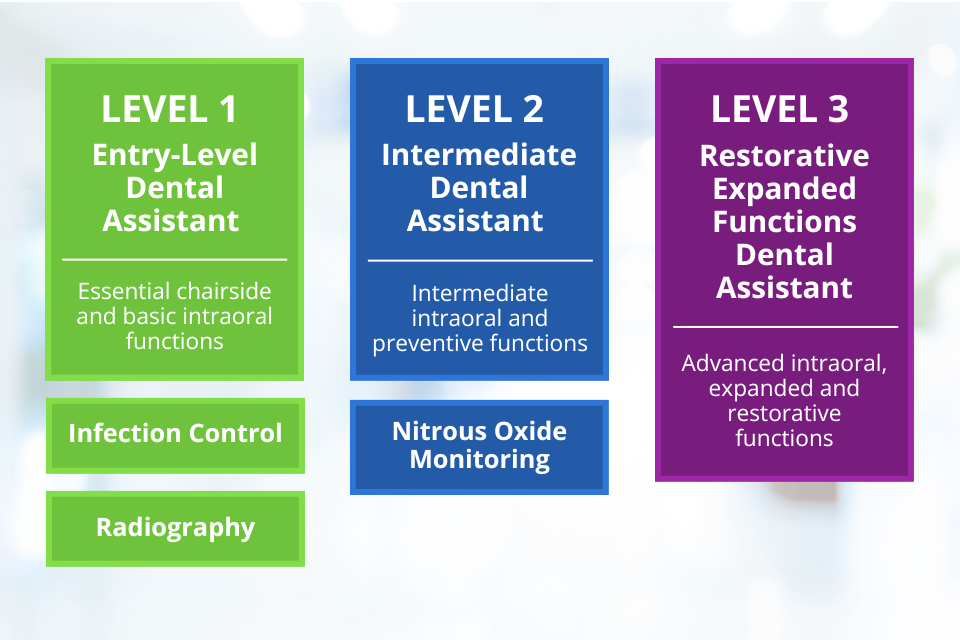
Three Levels of Dental Assistant
The model outlines three levels of dental assistant work, with increasing levels of responsibility and independence. The model establishes two pathways for advancement. Assistants may receive on-the-job training and pass a national exam or complete a board-certified dental assisting course. The model further establishes recommended standards for course content and foundational knowledge at each level. As new technologies and procedures develop, the model features guidelines and criteria for assigning tasks to the appropriate level of dental assistant.
Level 1: Entry Level
Entry-level dental assistants have the highest level of supervision. No prior work experience is required, but these dental assistants should receive training in infection control, basic radiation safety, and hygiene practices. Assistants at this level handle essential chairside responsibilities, including:
- Administrative tasks
- Assisting in the field of operation during dental procedures
- Maintaining infection-control protocols
- Taking vital signs
- Providing patients with preventive education and oral hygiene instruction
Level 2: Intermediate
The second level introduces more technical and higher-risk intraoral procedures. Any Level 1 dental assistant can advance to Level 2 by completing a board-approved course and passing a national exam. Graduates of an accredited program may also begin as level 2 assistants if their program covers all requirements. Responsibilities may include:
- Coronal polishing
- Applying sealants
- Fabricating or placing temporary crowns
- Removing periodontal dressings
- Monitoring nitrous oxide
Level 3: Restorative Expanded Functions
This is the most advanced scope of practice in the model. Advanced assistants can perform expanded restorative procedures and other high-skilled tasks, sometimes with only indirect supervision of a dentist. Key tasks include:
- Placing liners and bases
- Placing and cementing prefabricated crowns
- Advanced restorative procedures requiring knowledge of oral anatomy
Conclusion
The model offers a workable solution to improve state-to-state consistency. By defining levels clearly and standardizing training pathways, the model will help attract new people to the profession, encourage dental assistants to advance their careers, and improve efficiency in dental offices.