
This year, NCOHC is exploring different aspects of the Oral Health Workforce. In the past few months, we have explored the Old North State Dental Society’s efforts to improve and diversify the pipeline for dental schools and the role of FQHCs in addressing high-need locations. In this installment, we aim to understand the scope of the workforce shortage and why the progress made in North Carolina’s dental workforce still leaves room for improvement.
Historical Trends
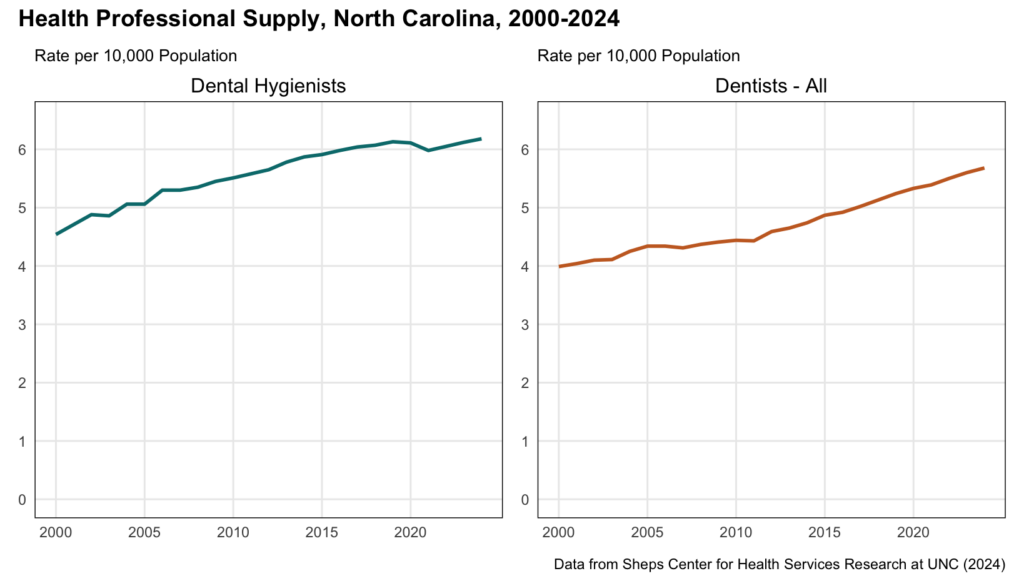
Between 2000 and 2024, North Carolina saw a dramatic 93.5% increase in the total number of dentists from 3,225 in 2000 to 6,241 in 2024. The supply of dental hygienists has seen a similarly robust increase of 76.5% during the same 2000 and 2024 period, growing from 3,669 to 6,784. Accounting for state population growth, this represents a 42.4% rise in dentists per 10,000 residents and a 36.1% increase in hygienists per 10,000 residents.
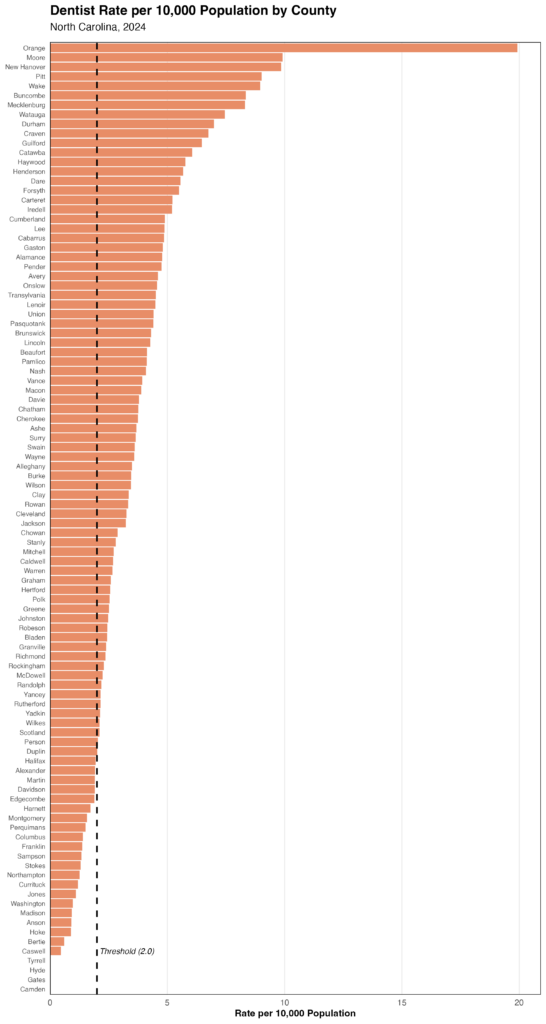
This expansion has fundamentally altered North Carolina’s standing compared to other states. In 2005, the state was ranked 47th in the nation for dentist supply relative to its population. By 2022, it had risen to 24th. Despite record-high numbers of dentists, the concentration of these professionals in urban hubs has created a huge disparity. As of 2024, more than 50% of all active dentists in North Carolina practiced in only six of the state’s 100 counties: Wake, Mecklenburg, Guilford, Orange, Durham, and Forsyth.
These six counties contain only 35% of the state’s total population, meaning that a much higher concentration of providers exists in the most affluent areas, while the remaining 94 counties must compete for the other half of the workforce.
In addition, the ratio of hygienists to dentists has begun to decline. After reaching a peak of 1.26 dental hygienists for every one dentist in 2011, the ratio decreased to 1.09 by 2023. While this shift could suggest a tightening labor market for hygienists compared to the expansion of dental school seats, the underlying causes remain unclear. The North Carolina Community College System (NCCCS) is making a concentrated effort to establish more dental hygiene programs to increase the number of graduating dental hygienists. Current programs graduate around 260 hygienists per year, with projected enrollment reaching 400 graduates per year by 2028.
While the state works to increase dental workforce, it is important to note that there is a significant lack of comprehensive workforce data regarding the whole dental team, especially for dental assistants and other auxiliary professions. Given these trends, North Carolina’s oral health workforce models should be studied in-depth to better understand workforce needs for our state.
What does it mean to be in a workforce shortage?
In general, an oral health workforce shortage is formally defined as a provider-to-population ratio of less than 2.0 providers per 10,000 residents. The designation is determined by the Health Resources and Services Administration (HRSA). The designation also considers poverty levels, water fluoridation, and geographic accessibility based on a 40-minute travel time standard. Furthermore, it accounts for a dentist’s actual productivity, factoring in their age and number of auxiliary staff they employ.
What is this designation used for?
HPSAs are used by the National Health Service Corps (NHSC) and other federal programs to distribute participants to where they’re needed most. While these ratios provide a baseline, they do not necessarily represent the “ideal” of provider concentration for optimal health outcomes. In many high-income metropolitan areas, the ratio is far higher than the federal minimum. For instance, Orange County, home of the UNC Adams School of Dentistry, has a ratio of nearly 20 dentists per 10,000 population, almost ten times the federal minimum threshold.
Shortage Areas
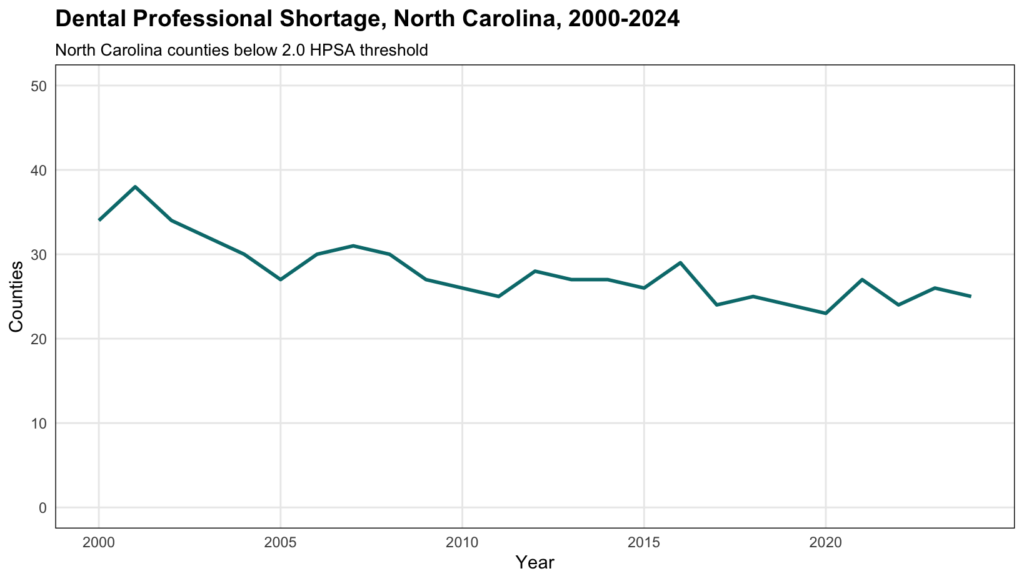
As of 2024, 93 out of North Carolina’s 100 counties contained at least one DHPSA. There are 25 counties that fell below the HPSA threshold of 2.0 providers per 10,000 residents on a whole-county level. While this represents progress since 2000, growth has remained largely stagnant for nearly two decades. In four rural counties in northeastern North Carolina, Tyrell, Hyde, Gates, and Camden counties, not a single practicing dentist is active. More needs to be done to encourage dentists to practice in these areas.
Conclusion
Over the last four decades, North Carolina has successfully transitioned from a period of severe provider scarcity to a much more substantial number of licensed professionals. However, as the data shows, the massive growth in our workforce has not occurred uniformly, leaving a stark “dental divide” between our six most affluent urban hubs and the remaining rural counties.
While the number of dentists has doubled, the workforce is concentrated in areas that already exceed federal minimums. To bridge this gap, we cannot simply rely on graduating more providers. We must change the incentive of where they choose to practice.
The upcoming installments of this series will discuss the NCIOM’s Oral Health Transformation Task Force recommendations, which provide a roadmap for this shift. Central to this transformation is the 2026 legislative push to overhaul Medicaid dental reimbursement rates. By narrowing the financial gap between private insurance and Medicaid, North Carolina aims to make rural practice and safety-net care a viable, sustainable choice for the next generation of providers.
NCOHC, a Foundation for Health Leadership & Innovation program, works to advance systems-level changes, improving the overall health and well-being of all North Carolinians by increasing access and equity in care. Sign up for our monthly newsletter to join the network and get involved!