
In our previous post, we explored the “dental divide” currently splitting North Carolina. While the state’s total number of dentists has doubled since 2000, half of those providers are concentrated in just six urban counties. The remaining 94 counties are being left behind, including four rural northeastern counties that currently have no practicing dentists.
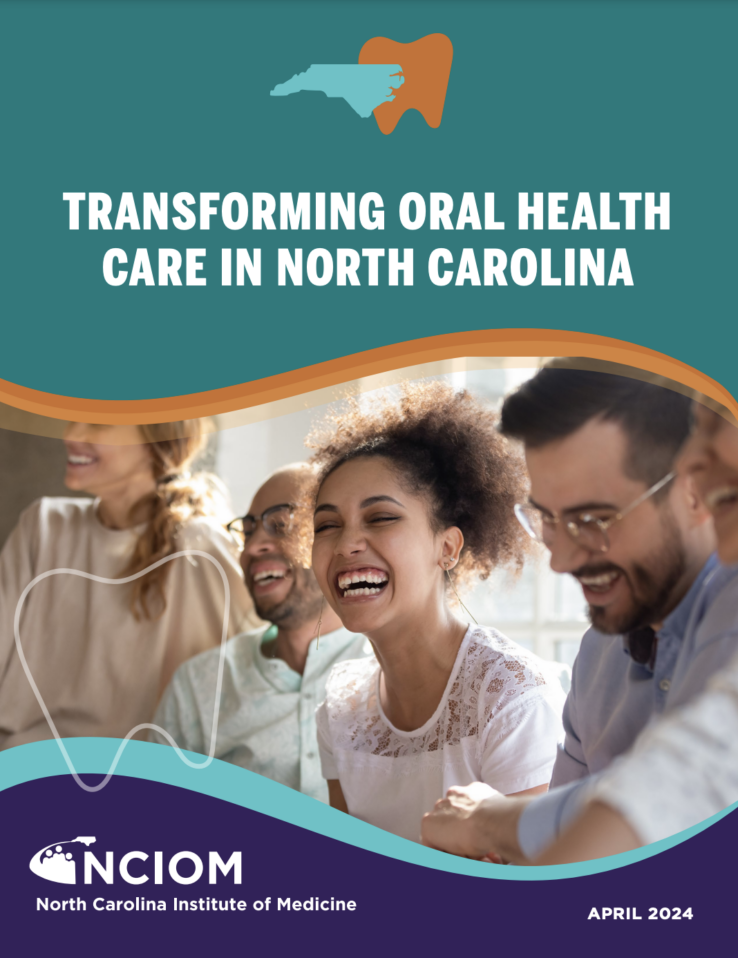
In 2024, the North Carolina Institute of Medicine published a report titled, Transforming Oral Health Care in North Carolina.1 Chapter 4 of this report lays out a 15-page blueprint to sustain a robust oral health workforce. Building on our theme of oral health workforce resilience and promotion, this month’s blog will explain this blueprint.
Dental teams in North Carolina consist of dentists, dental hygienists, and dental assistants. Dentists require a doctorate degree from a CODA-accredited institution and licensure from the North Carolina State Board of Dental Examiners. There are three dental schools in North Carolina: the University of North Carolina at Chapel Hill (UNC), East Carolina University (ECU), and High Point University (HPU).
Dental hygienists require an associate’s or bachelor’s degree and licensure from the state. There are 12 accredited community colleges offering Associate of Applied Science programs in Dental Hygiene, and one bachelor’s program at UNC. Dental Assistants are not licensed or certified. While the dental board maintains two classifications of dental assistants (I and II), the supervising dentists are legally responsible for verifying the dental assistant’s qualifications and overseeing allowed delegable functions.
The recommendations in this report focus on promoting growth and retention in all three of the professions that make up the dental team.
1. Incentivizing Rural and Safety-Net Practice (Recommendation 7)
The first priority in the report is to increase the number of dental team members practicing in rural areas. North Carolina has a large rural population and a significant disparity in oral health access between urban and rural areas. To encourage more students to join educational pathways, the report recommends evaluating Student Loan Forgiveness plans and increasing funding for the Community College system. For career advancement and retention, the task force recommends exploring career ladders for dental hygienists and assistants, along with more support for continuing education and training. Finally, the report recommends further collaboration between universities and state governmental programs to monitor workforce issues and provide better data.
2. Maximizing the Full Dental Team (Recommendation 8)
To improve the performance of the entire dental team, the report recommends reviewing and expanding the scope of practice for hygienists and assistants.
“The most efficient dental care delivery system is one where all the members of the dental team are practicing at the top of their training and licensure. This assures that all dental professionals providing direct care are performing the procedures that they are best suited to do,” says the report.
To accomplish this, the task force recommends coordinating with the North Carolina Dental Society, the North Carolina Dental Hygienists’ Association, and NCOHC to put together a plan for an expanded scope of practice.
This workforce shift could facilitate quicker access to essential treatments and preventative care.
3. Making the Pipeline Earlier (Recommendation 9)
An improved workforce depends upon a robust pipeline of students entering training programs. The task force recommends a program to expose more young people to oral health careers before they enter college. The strategy would add oral health career pathways to the school-based curriculum and include oral health pathways in North Carolina high school academies of medicine.
4. Supporting Professional Growth (Recommendation 10)
For undergraduate students and early-career dentists, hygienists, and assistants, their mentors have a huge impact on their future careers. These students and practitioners would benefit from more robust mentorship programs, with more pathways for experienced team members to become educators, instructors, and mentors. The report recommends further collaboration between dental schools and dental public health initiatives to cross-promote mentorship and education. This program could further train the oral health team in the values of whole-person care, to better integrate with the rest of the health care system.
5. Solving the Data Gap (Recommendation 11)
For any of these programs to work, they need accurate data about the state of oral health and the oral health workforce. The task force recommends improved ways of collecting and sharing data between local public health agencies, community coalitions, and state-level governmental programs. This would improve the availability of local-level data and make sure every community has the resources it needs to support evidence-based policy for oral health.
The Path Forward
The NCIOM Task Force recommendations explicitly link workforce sustainability to the need for a system of high-quality, cost-effective care that is “seamlessly integrated” into the broader health system. The plans are broad, and many of the recommendations set up further collaborations and programs to focus on the specifics of individual issues. NCIOM and NCOHC have plans to collaborate on future opportunities to explore these recommendations and further improve the oral health landscape in North Carolina.
As we look forward to Oral Health Day on October 16, NCOHC remains committed to collaborating with partners to find solutions that will expand the oral health workforce in rural communities in North Carolina. Our event will discuss training pipelines, scope of practice, policy, and paths forward.
- The report was funded by The Duke Endowment and the Foundation for Health Leadership and Innovation. ↩︎
NCOHC, a Foundation for Health Leadership & Innovation program, works to advance systems-level changes, improving the overall health and well-being of all North Carolinians by increasing access and equity in care. Sign up for our monthly newsletter to join the network and get involved!